
Warehouse Storage Guides
How to Choose the Right Pallet Racking System for Your Warehouse in 2027
A practical buyer's guide to pallet racking types, aisle widths, load capacity, safety standards and cost drivers — so you can choose the right warehouse racking system with confidence.

On this page62 sections
A pallet racking system is usually the single largest investment inside a warehouse after the building and the forklifts. It decides how many pallets you can store, how quickly your team can pick and dispatch stock, and how safely thousands of kilograms sit overhead every working day. Yet it is also one of the most commonly mis-bought systems, because the differences between racking types are easy to underestimate and expensive to discover later.
This guide explains how to choose a pallet racking system for your warehouse step by step. It compares the nine racking systems used in Indian warehousing today, works through aisle widths and forklift compatibility, explains pallet rack load capacity in plain language, shows how to calculate your warehouse pallet storage capacity, summarises racking safety and maintenance practice in India, and lists the factors that actually drive pallet racking system cost in India.
It is written for warehouse owners, factory managers, logistics and 3PL operators, procurement teams and anyone planning a new warehouse or upgrading an existing one. No special engineering knowledge is needed — and where a decision genuinely needs an engineer, the guide says so.
What Is a Pallet Racking System?
A pallet racking system is a steel storage structure designed to hold palletised goods on horizontal load beams between upright frames. Pallets are stored in layers rather than stacked on top of each other, which protects the goods, uses the building's height and keeps every load supported on engineered steel instead of on the product below it.
A typical pallet racking system has two kinds of parts. The static structure is made of upright frames bolted to the floor, horizontal beams that carry the pallets, and bracing that keeps everything square and stable. The accessories — row spacers, anchors, column guards, safety pins, wire mesh decks and load notices — make the installation safer and easier to work with day to day.
What changes from one system to another is how pallets are accessed. In a selective rack every pallet is reachable at any time. In a drive-in rack the forklift enters the rack itself. In a pallet flow or push-back rack, pallets move on gravity or on trolleys. Each access model trades storage density against selectivity, speed and cost — which is exactly why choosing the right one matters, and why the next section matters before any comparison table.
Why Choosing the Right Warehouse Racking System Matters
The cost of choosing the wrong racking system rarely appears on the quotation. It appears later, spread across years of operation:
- Wasted building height. A warehouse with a 9 m clear height that is fitted with two pallet levels stores roughly half of what the same shell could store with four or five.
- Wasted floor area. Aisles that are wider than the chosen forklift needs quietly consume 15–30% of a warehouse's footprint.
- Throughput bottlenecks. A high-density system that matches your inventory profile badly — for example drive-in racking for fast-moving, high-turnover SKUs — creates daily queues at the rack face.
- Safety exposure. Undersized beams, missed anchoring or ignored damage inspections turn a storage system into a structural risk.
- Re-purchase cost. Racking that cannot take the loads, heights or trucks you grow into often has to be replaced, not extended.
On the other side, a racking system that matches your pallets, loads, building and handling equipment does three things at once: it stores more in the same shed, it moves orders faster with the same team, and it protects both people and stock. That is why the choice deserves the structured approach this guide follows — not a catalog pick based on a photo.
Types of Pallet Racking Systems for Warehouses
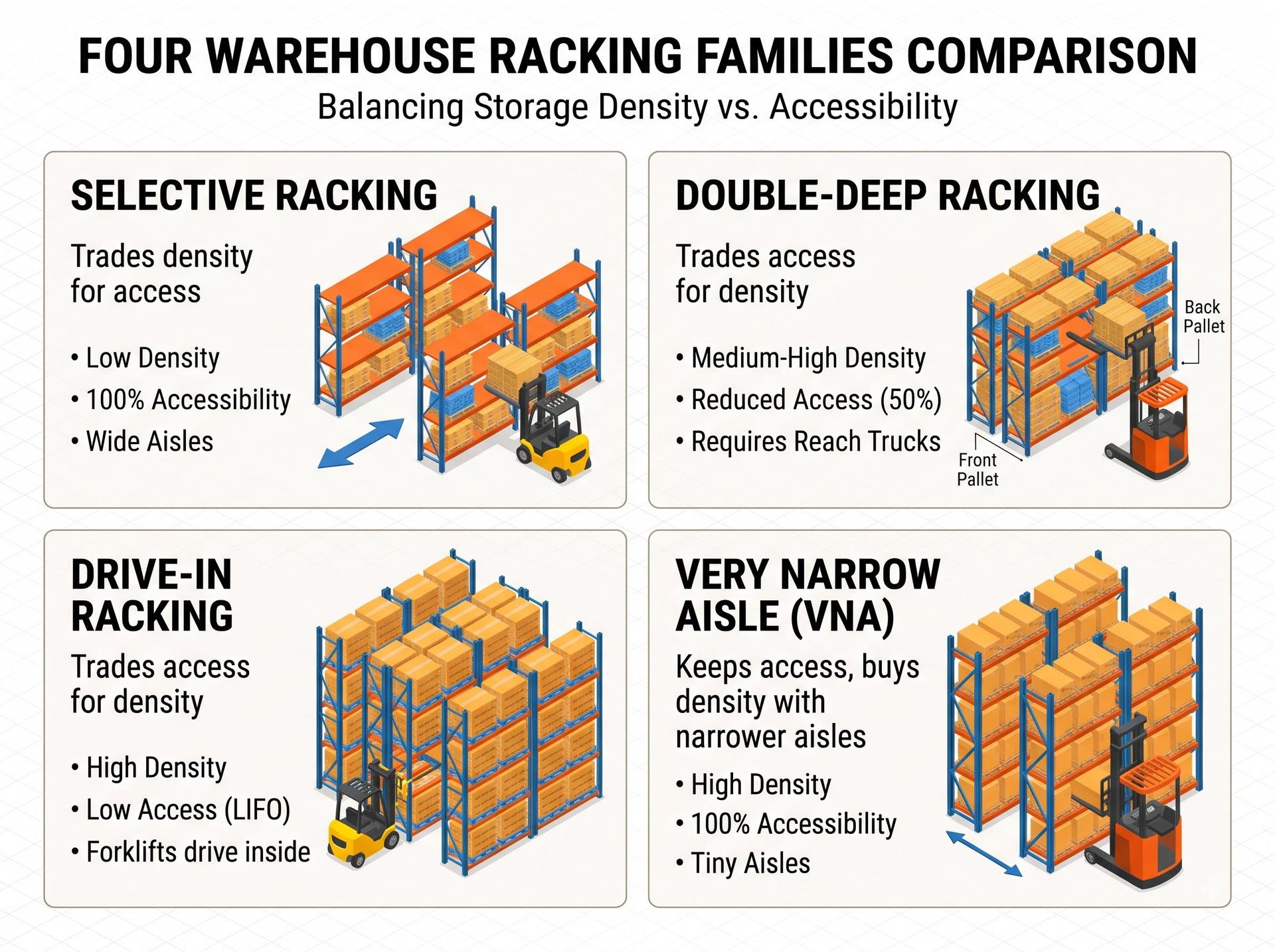
Nine systems cover almost every pallet racking installation you will see in India. For each one, the questions to keep in mind are the same: How directly can the forklift reach a pallet? How densely does it store? What does it ask of your building, your trucks and your inventory profile?
1. Selective Pallet Racking
Selective pallet racking — often called a conventional pallet racking system — is the most widely used racking type in the world. Every pallet position is directly accessible from the aisle, every pallet can be the next one out, and bays can be re-pitched with a mallet and a spare pair of hands when pallet sizes change.
Its strengths are flexibility, visibility and speed of access; its trade-off is density, because each row needs its own aisle. Selective racking suits operations with many SKUs, mixed pallet sizes, FIFO stock rotation and medium to fast movement per pallet. It is also the system most warehouses start with, because it adapts as the business grows.
2. Double-Deep Pallet Racking
Double-deep racking places two pallet positions back to back, so the forklift stores and retrieves the second pallet with a telescopic or double-reach carriage. One aisle now serves four rows of racking, which cuts aisle count and raises storage density by roughly 30–50% over selective racking in the same shell.
The trade-offs are meaningful: access is LIFO within each double row, the inner pallet is blocked until the outer one leaves, and you need a reach truck rather than a standard counterbalance forklift. Double-deep works best when you hold several pallets of the same SKU, when stock rotation within a batch is not critical, and when floor space is the constraint you are solving for.
3. Drive-In and Drive-Through Pallet Racking
Drive-in racking removes the per-row aisle entirely: the forklift drives inside the rack on rails, placing pallets on support rails bay by bay. A drive-in installation is loaded and unloaded from one side, while drive-through has openings on both faces so goods enter from one end and leave from the other.
This is the highest-density static system — it routinely stores 60–90% more pallets than selective racking in the same footprint — and it is a natural fit for cold stores and seasonal bulk goods, where a small number of SKUs arrive and leave in large batches. In return it gives up selectivity almost completely, requires careful, experienced forklift operation, and is inherently LIFO in its drive-in form. For temperature-controlled sites, drive-in remains the standard answer for freezing chambers where every square metre is expensive.
4. Push-Back Pallet Racking
Push-back racking stores pallets two to six deep on inclined carriages or wheel sets. The first pallet sits at the front; when the forklift places the next pallet, it pushes the row back along the incline. Retrieval works in reverse, so each lane operates LIFO, but the forklift never enters the rack.
Push-back offers much of drive-in's density with far better access, which makes it attractive for medium-SKU-count operations holding multiple pallets per SKU. In India it is far less common than selective, double-deep or drive-in systems, and the hardware is more complex — lanes of carriages and rails that need proper installation and periodic checking. Treat it as a specialist option to be evaluated against your real inventory profile, not a default.
5. Pallet Flow Racking
Pallet flow racking loads pallets at one end of a gently inclined lane fitted with rollers or wheel rails; gravity carries each pallet to the discharge end. The result is genuine FIFO stock rotation with very high density and a clean separation between loading and picking faces — valuable in production feeding, cold stores and dispatch-oriented operations.
Flow lanes are tuned to a specific pallet type, weight and speed profile, and they need well-made, undamaged pallets to run reliably. That is why pallet flow is specified rather than improvised: it suits operations with standardised pallets and a stable SKU mix, and it loses its advantage quickly where pallet quality or load weights vary widely.
6. Very Narrow Aisle (VNA) Pallet Racking
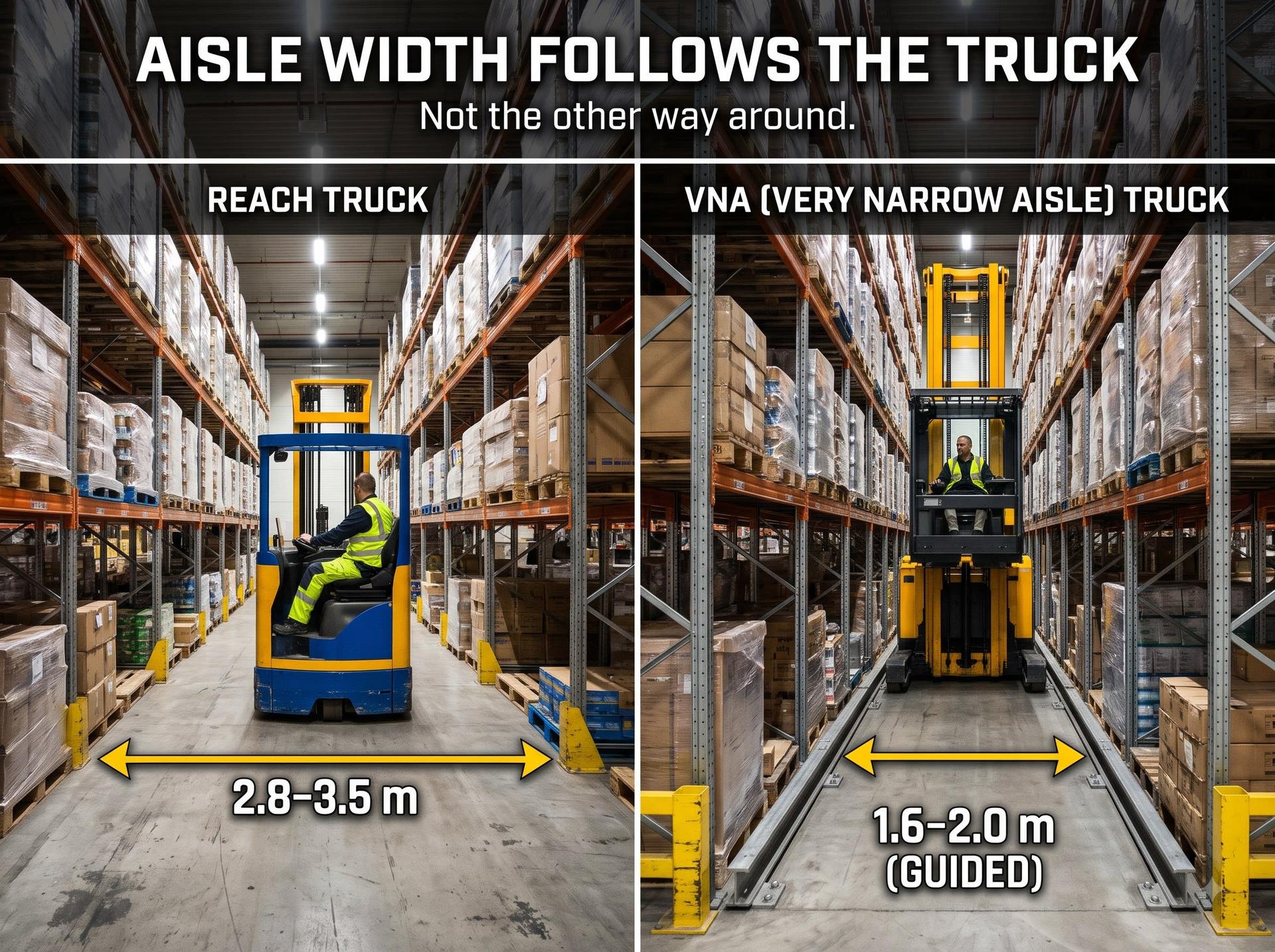
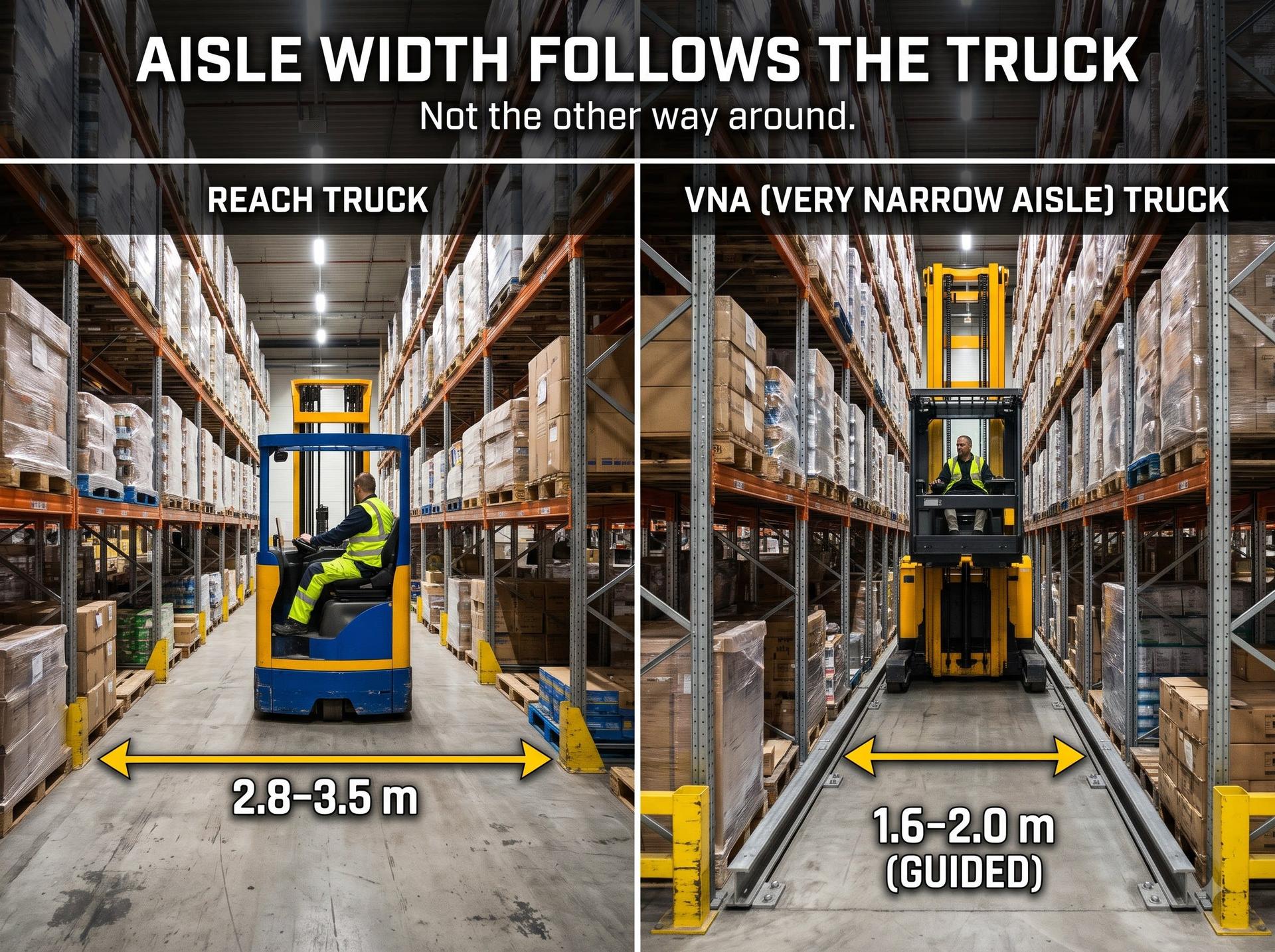
VNA racking keeps selective racking's full accessibility but compresses the aisle: specialised very narrow aisle trucks with wire or rail guidance work in aisles of roughly 1.6–2.0 m, against the 2.8–3.5 m a reach truck typically needs. For a given shell, VNA can increase pallet positions by a third or more compared with conventional selective racking.
The system asks more of the building than any other static option: floor flatness in the aisles must meet the truck supplier's specification, guidance rails or wire systems must be installed, and truck and rack tolerances must be treated as one engineering system. VNA is at its best in tall, high-throughput distribution buildings where land is costly and order lines are many.
7. Radio Shuttle Pallet Racking
Radio shuttle racking places a battery-powered shuttle cart inside each storage lane. The cart carries pallets along the rail deck, so the forklift only ever works at the lane entrance. Density approaches drive-in levels, while FIFO or LIFO sequence depends on how the shuttle is tasked, and one cart can serve several lanes.
The gains are real — deep lanes, less truck travel, less rack contact damage — but so are the commitments: shuttles and charged spare batteries to own and maintain, lanes engineered to a defined pallet spec, and a bigger investment than any static system. Radio shuttle makes sense for high-volume, low-SKU-count flows such as beverages, FMCG bulk lines and cold stores; it rarely pays for slow-moving, high-SKU inventories.
8. Mobile Pallet Racking
Mobile pallet racking mounts entire racking rows on motorised carriages that slide on floor rails. At any moment only one aisle is open; the rest close up, so the same pallets can be stored on a fraction of the floor area. Selectivity is unchanged — every pallet stays directly accessible once its row is opened.
This is the space-saving answer where land or cold volume is the dominant cost and throughput is moderate: freezers, archives and high-value goods stores are classic users. In exchange, every aisle move takes time, the floor rails and drives are a permanent engineering commitment, and throughput is limited to one open aisle at a time. Mobile racking is a deliberate, engineered choice — not an incremental upgrade.
9. Automated Pallet Racking / ASRS
Automated storage and retrieval systems (ASRS) replace the forklift with stacker cranes, shuttle systems or robotic carriers that place and fetch pallets under software control. Fully automated high-bay stores routinely work above 30 m and deliver the highest density and consistency available, with lights-out operation and precise inventory control.
Automation is a business-case decision with long lead times, significant building works and a vendor ecosystem of its own — well beyond the scope of a first racking purchase. Most Indian warehouses reach their goals with well-planned static racking, and approach automation later, if throughput growth justifies it. Treat ASRS as a separate project to be studied properly, not a racking type to be quoted casually.
Pallet Racking System Comparison Table
The table below compares the nine systems on the dimensions that decide most purchases. Aisle width and density figures are typical ranges for standard 1200 × 1000 mm pallets with common forklifts — your truck supplier and rack designer should confirm the exact numbers for your equipment.
| System | Typical aisle width | Storage density | Access / rotation | Best suited for |
|---|---|---|---|---|
| Selective pallet racking | 2.8–3.5 m (reach truck) | Baseline (lowest) | 100% selectivity, FIFO or LIFO | Many SKUs, mixed pallets, fast, varied movement |
| Double-deep pallet racking | 2.8–3.5 m (reach truck) | +30–50% vs selective | LIFO within each double row | Several pallets per SKU, space-constrained sites |
| Drive-in / drive-through racking | None (truck inside rack) | Highest static density | LIFO (drive-in), FIFO lanes (drive-through) | Cold stores, seasonal bulk, few SKUs in batches |
| Push-back pallet racking | Standard reach aisle | High | LIFO, 2–6 deep | Medium SKU count, multiple pallets per SKU |
| Pallet flow racking | Loading aisle only | Very high | True FIFO by lane | Standardised pallets, production feed, dispatch |
| VNA pallet racking | 1.6–2.0 m (guided truck) | High (height + narrow aisles) | 100% selectivity, FIFO or LIFO | Tall buildings, high throughput, costly land |
| Radio shuttle racking | Lane entrance only | Very high | FIFO or LIFO by task | Beverages, FMCG bulk, cold stores, deep lanes |
| Mobile pallet racking | One open aisle at a time | Highest for selective access | 100% selectivity | Freezers, archives, high-value, moderate throughput |
| Automated pallet racking / ASRS | Machine aisle (enclosed) | Highest overall | Software-defined | Very high throughput, high-bay sites, long-term projects |
10 Important Factors to Consider When Choosing a Pallet Racking System
Almost every racking regret traces back to one of ten factors. Work through them in order — each one narrows the field of suitable systems.
1. Pallet Size, Type and Condition
Measure your loaded pallets — length, width and height with the load overhanging or shrink-wrapped — and count how many pallet sizes you actually run. A rack bay is designed around a pallet profile: beam lengths, beam pitch and depth all follow from it. Damaged or non-standard pallets argue for systems tolerant of imperfection (selective, wide-aisle) and against precision systems such as pallet flow or radio shuttle.
2. Load Weight per Pallet
Record the maximum weight per loaded pallet and the spread between your lightest and heaviest SKUs. Weight drives beam pair ratings, frame design, the number of storage levels you can afford, and your forklift choice. Heavier loads usually mean fewer levels, stronger sections and a higher system cost per position — knowing the number early prevents designing twice.
3. Clear Height and Building Constraints
Measure the clear height under the lowest obstruction — sprinkler lines, light fittings, roof trusses and fans all reduce what you can build to, and insurance and fire-safety requirements may cap top levels. Note column positions, dock doors, floor joints and slopes. Two warehouses with the same footprint and height can hold very different pallet counts because of these details.
4. Aisle Width and Forklift Compatibility
Aisle width is where storage density is won or lost. As a rule of thumb, standard counterbalance forklifts need roughly 3.5–4.0 m aisles, reach trucks roughly 2.8–3.5 m, and VNA trucks roughly 1.6–2.0 m with guidance. The correct pallet racking aisle width calculation depends on your truck's turning and load-offset dimensions — ask your MHE supplier to state the aisle each truck model needs for your pallet, then let the rack layout follow. Locking this down before buying racks is one of the highest-value habits in warehouse planning.
5. Storage Density vs Selectivity
Every system trades direct access against density. Count how many SKUs you carry and how many pallets you hold per SKU. Many SKUs with few pallets each push you toward selective or VNA racking; few SKUs with many pallets each justify double-deep, drive-in, shuttle or flow systems. Getting this one match right decides most of the economics.
6. FIFO vs LIFO Stock Rotation
If your goods expire, age or are quality-checked in sequence, you need FIFO — selective racking, pallet flow, drive-through lanes, radio shuttle (configured for FIFO) and mobile racking all support it. LIFO-compatible systems — double-deep, drive-in, push-back — store more densely but the last pallet in is the first out. Match the rotation model to your goods, not the other way round.
7. Throughput and Speed of Operation
Estimate pallet movements per shift at peak. High-throughput operations feel every extra second of travel and every blocked pallet, which is where selectivity, shuttle systems or automation earn their cost. Low-throughput stores can accept deeper lanes and one-open-aisle systems to save space. Design for your peak day, not your average one.
8. Floor Quality and Anchoring
Racks are anchored to the floor, so the floor's thickness, strength and flatness matter — most importantly for VNA and other guided systems, where flatness tolerances are strict. Share your floor details (or ask for a floor survey) with the racking designer early. Retrofitting floor joints, levelled patches or guide rails after installation is far more expensive than planning for them.
9. Growth, Flexibility and Re-pitching
Ask what changes when your business changes. Selective racking re-pitches cheaply and extends bay by bay; deeper systems and guided or automated installations are far less forgiving. If your SKU mix, pallet sizes or volumes are still moving, weight flexibility accordingly — the cheapest system is often the one you will not have to replace.
10. Budget — Upfront Cost vs Lifetime Value
Compare quotations on cost per pallet position stored, not per tonne of steel. A denser system with a higher purchase price can be cheaper per pallet stored, and a cheaper rack that forces extra forklift hours or early replacement is not a saving. Include anchors, guards, decks, signage, installation and inspection in the comparison — and see the cost factors section near the end of this guide.
How to Calculate Warehouse Pallet Storage Capacity
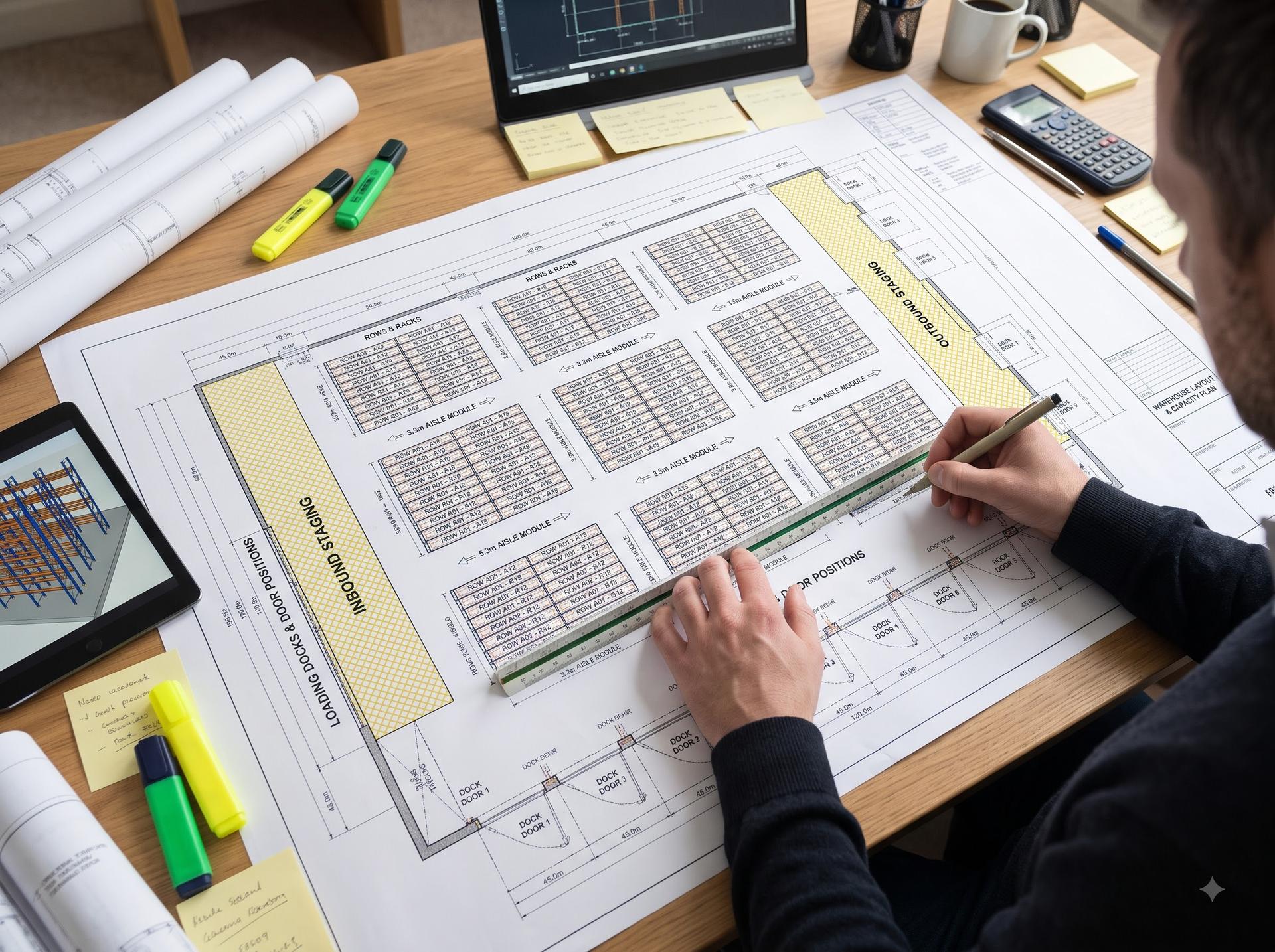
Before you compare racking systems, calculate what your building could hold — it changes the conversation from "what does a rack cost" to "what does a pallet position cost". The calculation below estimates selective racking capacity; denser systems replace the aisle allowance with their own geometry.
- Warehouse floor area. Length × width of the storage area (inside walls).
- Usable racking area. Deduct aisles, staging, docks, offices and fire lanes — typically 30–40% of the footprint in a selective layout.
- Pallet positions per level. Divide the usable area by the floor area each pallet position consumes (bay width and depth plus its share of the aisle).
- Levels. Divide your clear height by the vertical pitch per pallet level (pallet height plus clearance, typically 1.5–1.9 m).
- Total positions. Positions per level × levels — then sanity-check against truck lift heights and sprinkler clearances.
Worked example — 40 m × 20 m warehouse, 9 m clear height
Assume a 40 m × 20 m shed (800 m²) with 9 m clear height, storing 1200 × 1000 mm pallets loaded to 1.5 m and 800 kg. Plan 14 bays per row (bay length 2.7 m = two pallets side by side with clearance), back-to-back rows of 2.4 m depth, and 3.0 m reach-truck aisles. Each aisle-plus-double-row module is 5.4 m wide, so the 20 m width fits three modules plus one single row against a wall: 3 double rows + 1 single row. At 14 bays per row and 2 pallets per bay, that is 98 pallet positions per level. A 1.8 m vertical pitch gives four levels within 9 m clear height, with head room for sprinklers and truck clearance.
| Step | Input / rule used | Result |
|---|---|---|
| Floor area | 40 m × 20 m | 800 m² |
| Rows in plan | 3 back-to-back double rows + 1 wall row (5.4 m module width) | 4 rows |
| Bays per row | 40 m ÷ 2.7 m per bay (allowing staging at one end) | 14 bays |
| Positions per level | 14 bays × 2 pallets × 3 double rows + 14 × 1 wall row | 98 positions |
| Levels | 9 m clear height ÷ 1.8 m pitch (four levels, ground included) | 4 levels |
| Total capacity | 98 positions × 4 levels | ≈ 390 pallet positions |
Understanding Pallet Rack Load Capacity and Specifications
Racking capacity is quoted per component, and the numbers are not interchangeable. The three you will meet on every quotation:
- Beam pair load capacity — the safe working load a pair of beams carries per level, assuming the load is evenly distributed. A "1500 kg beam pair" does not mean 1500 kg concentrated on one pallet, and it does not mean 1500 kg per beam.
- Frame (upright) load capacity — the total a vertical frame can carry when every level is loaded to its limit. Frames carry the accumulated weight of all levels above, which is why tall bays with heavy pallets are designed, not assembled.
- Bay load capacity — the combined figure for a complete bay, usually stated on the load application sign fixed to the frame.
Three specifications do most of the work behind those numbers: the steel grade and section of the uprights and beams, the beam-to-upright connection (its locking device and its tested performance), and the anchoring that ties the structure to the floor. When a supplier quotes a capacity, ask which figure it is, per level or per bay, and at what pallet spacing — then make sure the load application sign matches the design.
For most Indian warehouses storing 500–1000 kg pallets over three to five levels, properly designed selective or heavy duty pallet racking in India is well within standard engineering practice — the point of this section is not to make you an engineer, but to make the quotations you receive comparable and the load signs on your racks meaningful. For a deeper worked treatment of ratings and signs, see our pallet rack load capacity guidance in the industrial racking systems overview.
Essential Components of a Pallet Racking System
Knowing the parts by name makes quotations comparable and damage reports precise. The components that matter in every pallet racking system:
- Upright frames — the vertical columns, connected by diagonal and horizontal bracing; they carry the accumulated load down to the floor anchors.
- Load beams — the horizontal members pallets sit on, hooked into upright slots; their pair rating defines the level.
- Base plates and anchors — the feet and the floor bolts that resist overturning; correct anchoring is a safety-critical installation step.
- Safety pins / beam locks — small devices that stop a beam being knocked off its connector by a rising pallet.
- Column guards and end protectors — sacrificial steel barriers protecting uprights from forklift impact at aisle ends and doorways.
- Row spacers — fix back-to-back rows at a set distance, keeping the flue and alignment designed into the layout.
- Wire mesh decks / timber or steel battens — support non-palletised or unstable loads between beams where used.
- Load application notices — the sign on each bay stating its design loads; the reference your team and inspector both use.
Warehouse Racking Safety Standards and Maintenance
A racking installation is a structure, and structures are managed. In India there is no single, universally mandated racking code; suppliers commonly design to established international racking design practice together with Indian structural steel codes, and good operators then manage the installation with their own inspection regime. Which exact design standard and inspection schedule applies to your site should be stated by your supplier and confirmed with your safety officer — this is a question to ask before ordering, not after.
Whatever the design basis, the operating practices that keep racks safe are consistent across the industry:
- Regular inspections. A practical pattern is a documented walk-through by trained warehouse staff (often weekly or fortnightly), with a more thorough documented inspection on a scheduled cycle — commonly annual — by a competent person. Match the frequency to your traffic and damage rate.
- Damage reporting and repair. Bent uprights, buckled bracing, dropped beams and damaged anchors take the rack out of its designed state. Report immediately; repair or offload damaged positions using a supplier-approved method.
- Load discipline. Store nothing above the loads on the bay's load notice. Heavier pallets on upper levels, uneven loading and overhanging loads all push a rack outside its design assumptions.
- Impact control. Column guards, aisle-end barriers, sensible speed limits and forklift driver training reduce the damage that starts most rack failures.
- Floor and anchoring checks. Confirm anchors remain tight and floor joints under frames have not deteriorated, especially after any building works.
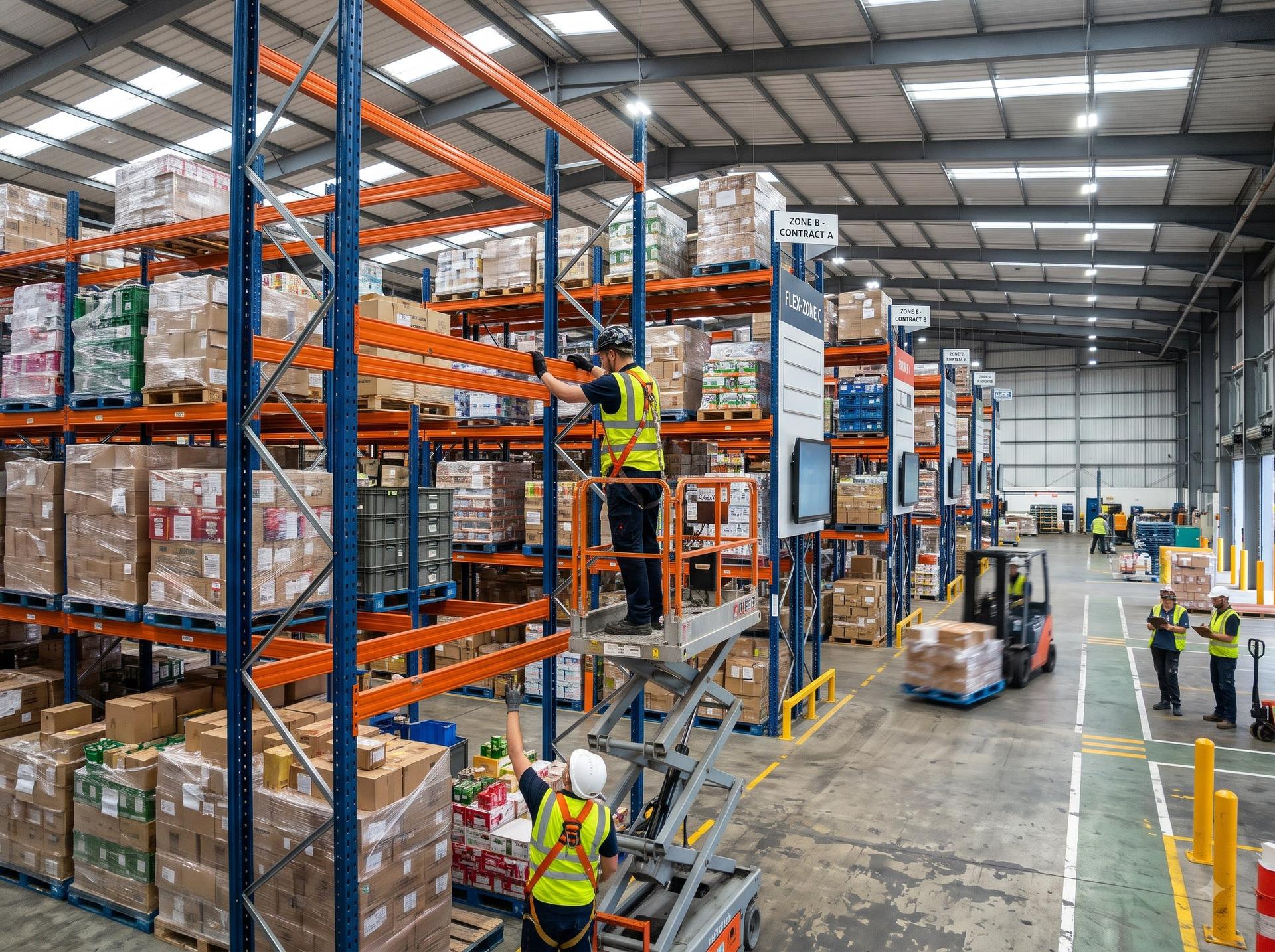
If you inherit racking with no documentation — a common situation in leased warehouses — arrange an engineering inspection before raising loads, and re-create load notices from the inspection findings. Our after-sales support service covers inspection, repair and re-configuration for existing installations, including systems originally supplied by others.
Which Pallet Racking System Is Best for Different Industries?
Inventory profile, rotation rules and building economics differ by sector, and so does the racking that fits. These are the patterns that hold across most Indian operations in each industry.
E-commerce and Quick Commerce
Fast order lines, many SKUs and relentless seasonal peaks. Selective racking for reserve pallets combined with shelving or mezzanine pick faces is the common backbone, with capacity staged for sale events. See our e-commerce warehousing storage applications.
3PL and Multi-Client Warehouses
Clients change, pallet profiles vary and flexibility is the product. Selective racking dominates because it re-pitches and re-zones quickly, with double-deep or drive-in zones for clients with deep, stable stock. The logistics facilities sector, including 3PL and e-commerce fulfilment hubs, rewards systems that can be reconfigured between contracts without scrap.
FMCG and Retail Distribution
High volume, few SKUs per brand, strong rotation. Selective racking for case-flow areas, with double-deep, drive-in or shuttle systems for bulk reserve stock of fast movers — density wins here because the same SKUs move constantly. FMCG warehouses are the classic ground for deeper-lane systems.
Food, Beverage and Cold Storage
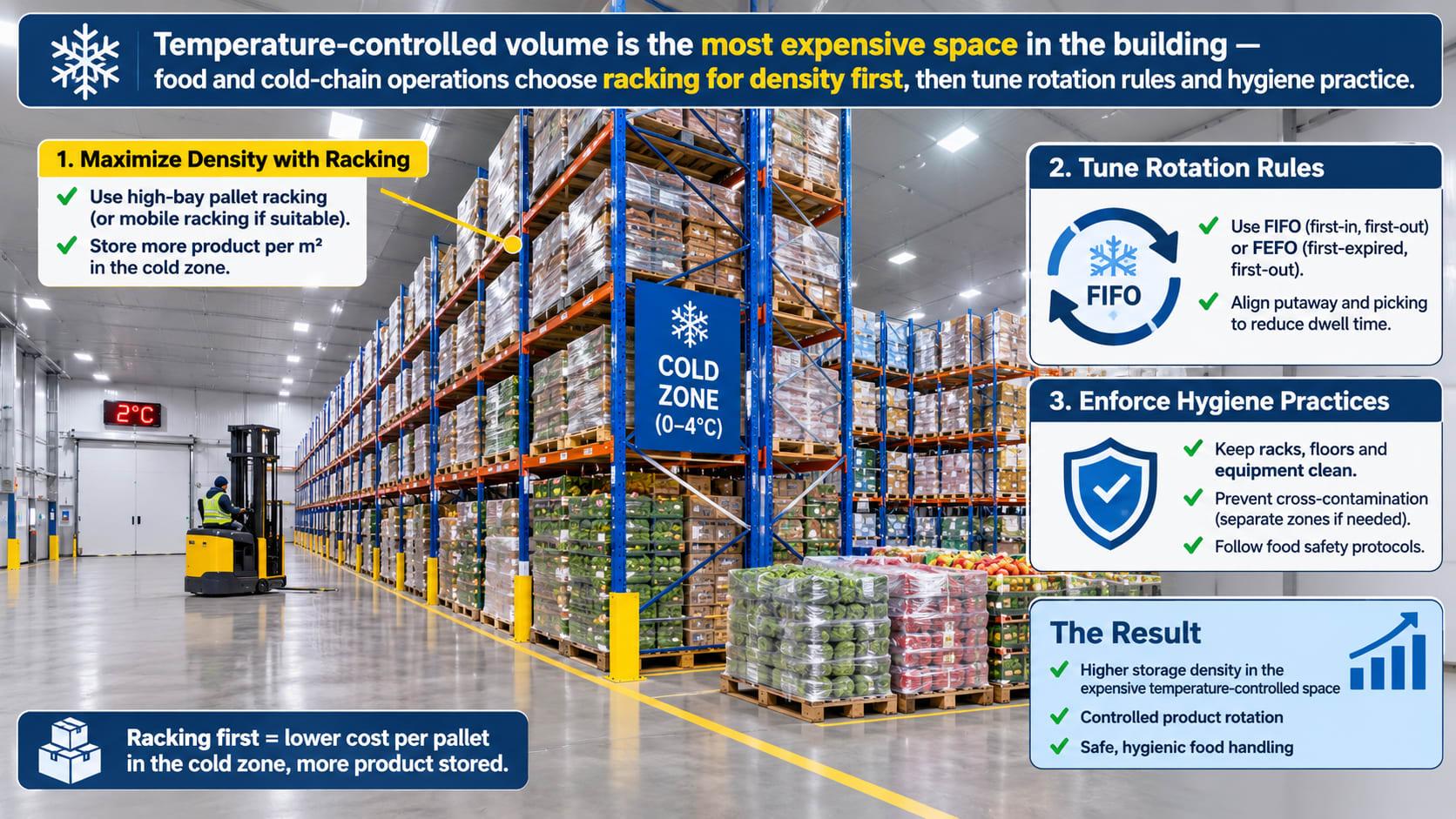
Temperature-controlled volume is expensive, so density rules — drive-in and shuttle racking in freezing chambers, flow or drive-through where FIFO is strict, and materials and finishes suited to low temperatures and wash-down practice. Hygiene, condensation and door discipline matter as much as the rack itself.
Pharmaceuticals
Batch traceability, expiry control and audit discipline. Selective racking (for full lot visibility) with dedicated quarantine and clearance zones, and mesh decks or trays where picks are manual. Storage conditions and documentation practices carry over into how the racking is zoned and signed — see pharmaceutical warehouses.
Automotive and Auto Ancillary
A mix of heavy pressed parts, bulky components and small bins. Pallet racking for heavy sub-assemblies, cantilever and long-span for extrusions and bars, plus mezzanine or shelving tiers for service parts — component diversity, more than raw tonnage, drives the layout.
Manufacturing Plants
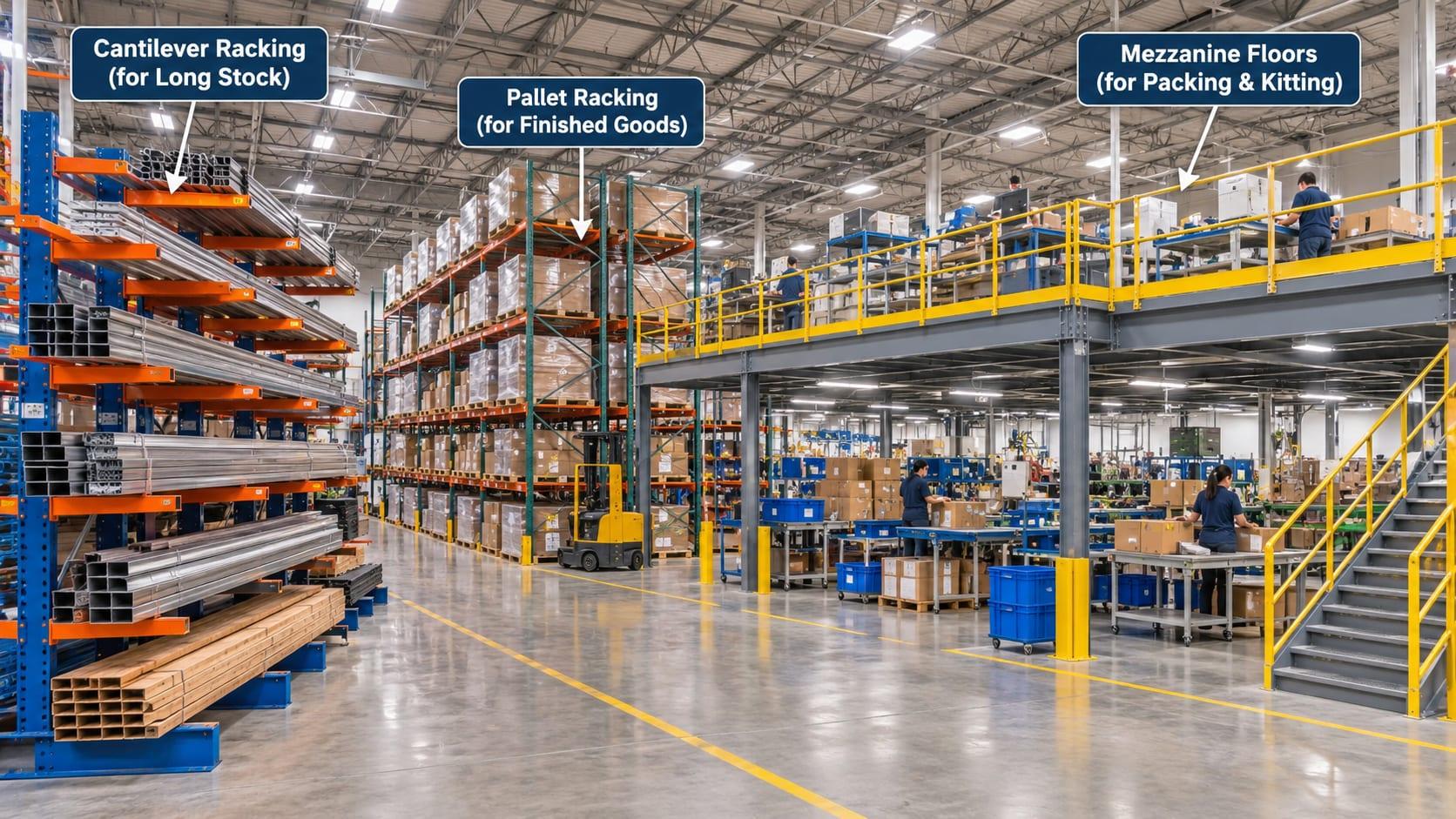
Raw materials in, finished goods out, with production feeding the schedule. Pallet racking near the line for feeding (flow or shuttle where justified), heavy duty racking for finished pallets, and mezzanine floors to add floor area for kitting or packing without extending the shed — a common combination in manufacturing storage.
Chemicals and Lubricants
Drums, cans and palletised liquids with segregation and spill considerations. Heavy duty selective racking with strong beam pairs, drum-specific handling attachments, and close attention to fire-safety and stacked-height rules for flammable or hazardous classes — always designed with the applicable safety approvals in view.
Hardware, Pipes and Building Materials
Long, heavy, awkward stock — pipes, profiles, timber, sheets. A cantilever racking system carries the long loads, with pallet racking for boxed goods; floor loading and forklift reach dominate the layout more than pallet count.
Pallet Racking System Cost in India: What Affects Pricing?
There is no honest single price for a pallet racking system in India: it is quoted per pallet position, and that figure moves with your building and your loads. The factors that move it most:
- System type. Selective racking is the baseline; double-deep adds components per position; drive-in, push-back, flow, shuttle and mobile systems each add engineered hardware — and price — per position.
- Height and levels. Taller systems store more per position but need heavier uprights, more demanding installation and sometimes costlier trucks.
- Steel weight and section. Pallet weight, beam spans and levels decide the steel in the quote. Two warehouses with the same pallet count can carry very different steel weights.
- Quantities and standardisation. Repeated identical bays cost less per position than short runs of special sizes.
- Accessories and safety items. Column guards, mesh decks, row spacers, signage and anchoring are modest individually and important in total — budget for them.
- Site conditions. Floor quality, working height restrictions, phased installation over live operations and travel distance all affect installation cost.
- Finish, compliance and documentation. Coating systems, testing and engineering documentation are part of the price of a rack that lasts and can be audited.
When you compare quotations, normalise everything to cost per pallet position stored at your confirmed load and height, including installation and accessories. That single number, applied consistently, makes a selective quote and a denser system's quote comparable on the thing you are actually buying — storage. For worked examples of how rack type and steel change price, see our guide to industrial racks in Mumbai.
Common Mistakes to Avoid When Buying Pallet Racking
These are the errors we see most often when a warehouse asks us to review or rescue an installation:
- Designing to average loads. The rack meets the heaviest pallet sooner or later; design for it, and put the number on the load notice.
- Buying racks before the forklift is fixed. Aisle width and rack height are hostage to the truck — decide the MHE first, or at least simultaneously.
- Ignoring clear height. Designing to slab or truss height instead of the clear height under sprinklers and lights wastes a level or two.
- Choosing density without checking rotation. A drive-in block for short-dated goods creates daily queues and write-offs; check FIFO/LIFO fit first.
- Skipping anchoring, guards and signage. Small line items, disproportionate safety consequences.
- Comparing quotes on steel tonnage. Compare cost per pallet position at equal loads and heights — otherwise you are comparing kilograms, not storage.
- No inspection or maintenance plan. Undocumented damage is how good racks become unsafe racks; a simple schedule prevents it.
- Forgetting growth. A layout with no spare module or re-pitch headroom will be replaced, not extended.
How to Choose the Right Pallet Racking Manufacturer in India
A racking system is manufactured steel plus engineering plus installation plus support — judge suppliers on all four. A practical checklist before you finalise a pallet racking manufacturer in India:
- Engineering, not just fabrication. Ask who performs the structural design, what design basis is used, and whether load data is calculated per bay or copied from a catalogue.
- Documentation. A proper quotation states beam pair and frame capacities, levels, steel sections and the load-notice figures that will be supplied.
- Manufacturing quality. Steel sections, welding, tolerances and powder-coating quality — visit the factory or ask for third-party quality evidence if the system is large.
- Installation competence. Anchoring, plumb and level, torque and safety pins installed correctly; installation should be by trained crews with a method statement.
- After-sales commitment. Spares availability, repair parts, re-inspection and re-configuration support — racking is a 15–25 year asset.
- References you can verify. Similar scale and industry, and a site you can speak to directly.
- Transparent, comparable quotations. Per-position pricing with all accessories itemised, so you can compare like with like.
For a broader view of system types and how manufacturers differ, our industrial racking systems manufacturer in India guide and the industrial racks buyer's guide for Mumbai both walk through supplier evaluation in more depth.
Why Consider Rack & Stack Storage Systems?
Rack & Stack Storage Systems Pvt. Ltd. manufactures and supplies industrial storage systems for warehouses and factories across India. Our core pallet racking offering covers conventional selective pallet racking systems and heavy-duty pallet racking for demanding loads, alongside cantilever racking systems for long materials and mezzanine floors that add usable area inside your existing building.
What we ask to be judged on is the process around the steel: a free site survey to measure your building and pallets properly, storage planning and warehouse layout planning based on your real inventory profile, in-house manufacturing with stated load data, installation by trained crews, and after-sales support for inspection, repairs and re-configuration as your operation changes. For deeper guidance beyond this article, browse the rest of our warehouse guides or contact us with your requirement.
Step-by-Step Process to Plan and Order Pallet Racking
Whether you work with us or not, a good racking project follows the same sequence — and the early steps decide the outcome:
- Site survey. Measure the building: clear height, floor, columns, doors, sprinklers, and confirm pallet sizes, weights and counts. A site survey is the foundation of every layout that fits.
- Requirement definition. State storage goals (pallet positions, throughput, rotation) and constraints (budget, timeline, phasing around operations).
- Layout and system selection. Compare candidate systems on capacity, throughput and cost per position; check aisle widths against the forklift fleet.
- Engineering and quotation. Finalise beam levels, frame loads, anchors, guards and signage; obtain an itemised quotation.
- Manufacturing. Confirm drawings, finish and delivery schedule; agree installation dates.
- Installation and handover. Install, anchor and inspect; fit load notices; walk the layout with your team and MHE supplier.
- Inspection and support cycle. Put the inspection schedule in place from day one, and keep a spares and repair contact on file.
Frequently Asked Questions
Which pallet racking system is best for a warehouse in India?
There is no single best system — selective pallet racking is the most common choice because it suits many SKUs, mixed pallets and FIFO rotation, while drive-in racking is preferred in cold stores and bulk-batch operations for its density. Match the system to your pallet profile, rotation needs and building height; the comparison table earlier in this guide is a good first filter.
What is the difference between selective pallet racking and heavy-duty pallet racking?
Selective describes access — every pallet is directly reachable — while heavy-duty describes capacity: heavier steel sections and higher beam-pair and frame ratings. A heavy-duty rack is usually still selective in layout; the difference is the loads and heights it is engineered to carry. Confirm both the access model and the load ratings in any quotation.
How much aisle width is required for pallet racking?
It depends on your forklift. As typical ranges: counterbalance forklifts need roughly 3.5–4.0 m aisles, reach trucks roughly 2.8–3.5 m, and guided VNA trucks roughly 1.6–2.0 m. Drive-in racking needs no aisle between rows because the truck enters the rack. Ask your forklift supplier to confirm the aisle width for your specific truck model and pallet.
What is the standard pallet size used in Indian warehouses?
The most common pallet footprint in India is 1200 × 1000 mm, with 1200 × 800 mm also widely used. Racking should always be designed around your pallet sizes and load overhang — a bay dimensioned for one pallet size wastes capacity or compromises safety with another.
How much weight can a pallet rack hold?
It depends entirely on the design: light-duty installations may carry a few hundred kilograms per level, while heavy-duty systems carry well over a tonne per beam pair with correspondingly rated frames. Never assume a generic figure — the capacity that matters is the one on the bay's load application notice, which should match the engineer's calculation for that design.
When should I choose double-deep racking instead of selective racking?
Choose double-deep when floor space is tight, you hold multiple pallets of the same SKU, and LIFO within a batch is acceptable. It typically stores 30–50% more than selective racking in the same footprint. If you need every pallet accessible at all times or run strict FIFO across the whole stock, stay with selective.
Is drive-in racking suitable for FIFO inventory?
Standard single-entry drive-in racking is LIFO — the last pallet in each lane is the first out. If your goods require strict FIFO, consider drive-through racking (loaded from one face, unloaded from the other), pallet flow racking, or a radio shuttle system configured for FIFO. Driving a lane to reach an older pallet in a drive-in block is not a FIFO method and adds rack-impact risk.
How tall can a warehouse pallet rack be?
Height is limited by your clear building height, your forklift's reach, sprinkler and insurance requirements, and the economics of taller steel. Many Indian warehouses work within 6–10 m of rack height; higher-bay and high-bay systems exist but demand more from the building, trucks and fire-safety design. Design to the clear height under the lowest obstruction, never to the roof sheet.
Do pallet racks require floor bolting and anchoring?
Yes — anchoring to the floor is a standard, safety-critical part of every pallet racking installation. The anchors resist overturning and are designed together with the frames. Racks delivered unanchored, or with anchors installed casually, are not in their designed state and should be corrected before loading.
What floor thickness and flatness is needed for pallet racking?
There is no single number: the racking designer needs to know your slab thickness, construction type and condition, and anchor lengths are selected accordingly. Flatness matters most for VNA and other guided systems, where the truck supplier will specify tolerances for the aisle. Share your floor drawings — or ask for a floor assessment — before the design is finalised.
Can pallet racking be customised for non-standard pallets?
Yes. Beam lengths, depths, pitches and accessories are selected to match your pallet sizes, and unusually heavy, long or awkward loads may call for heavier sections or a different system altogether (for example cantilever racking for long stock). Bring the real pallet dimensions and weights to the survey — customisation is normal practice, not an exception.
How much does a pallet racking system cost in India?
Cost is quoted per pallet position and moves with the system type, rack height, steel weight, quantities, accessories, site conditions and installation scope — so a single number quoted without your pallet loads and building details should be treated with caution. The reliable approach is an itemised quotation at your confirmed loads and heights, compared on cost per pallet position stored.
How long does pallet racking manufacturing and installation take?
It depends on the size and complexity of the system, the manufacturer's order book and the site's readiness — a small selective installation is a much shorter project than a multi-level, multi-zone build. Ask each supplier for a realistic manufacturing and installation schedule with agreed site-readiness conditions, and plan your operations around the installation window.
How often should pallet racks be inspected?
A common industry pattern is a documented walk-through by trained in-house staff at frequent intervals (often weekly or fortnightly) plus a more thorough documented inspection by a competent person on a scheduled cycle, commonly annual. The right frequency depends on your traffic, damage rate and risk assessment — agree a schedule with your supplier and record every inspection.
What details do I need before requesting a pallet racking quote from Rack & Stack?
The essentials are your warehouse dimensions and clear height, pallet sizes and maximum loaded weights, number of SKUs and required pallet positions, your forklift or stacker details, and your location with any timeline. Photos or a small plan help. Share these through our contact page or book a site survey and we will capture everything on site.
Conclusion: Choosing the Right Pallet Racking System
Choosing a pallet racking system is not about finding the best rack — it is about matching one of nine well-understood systems to your pallets, loads, building, trucks and growth. Start from your inventory profile and clear height, fix aisle widths with your forklift supplier, calculate your capacity before you compare prices, and buy from a manufacturer who puts engineering data, safe installation and after-sales support in writing.
Worked through in that order, the decision becomes almost mechanical — and the system you buy will still be the right one in 2030, not only in 2027.
Need Help Choosing the Right Pallet Racking System for Your Warehouse?
Rack & Stack can assess your warehouse space, pallet loads, forklift requirements and storage layout, and help you compare the systems in this guide against your own numbers — with honest advice even when the answer is "your current setup, re-pitched".
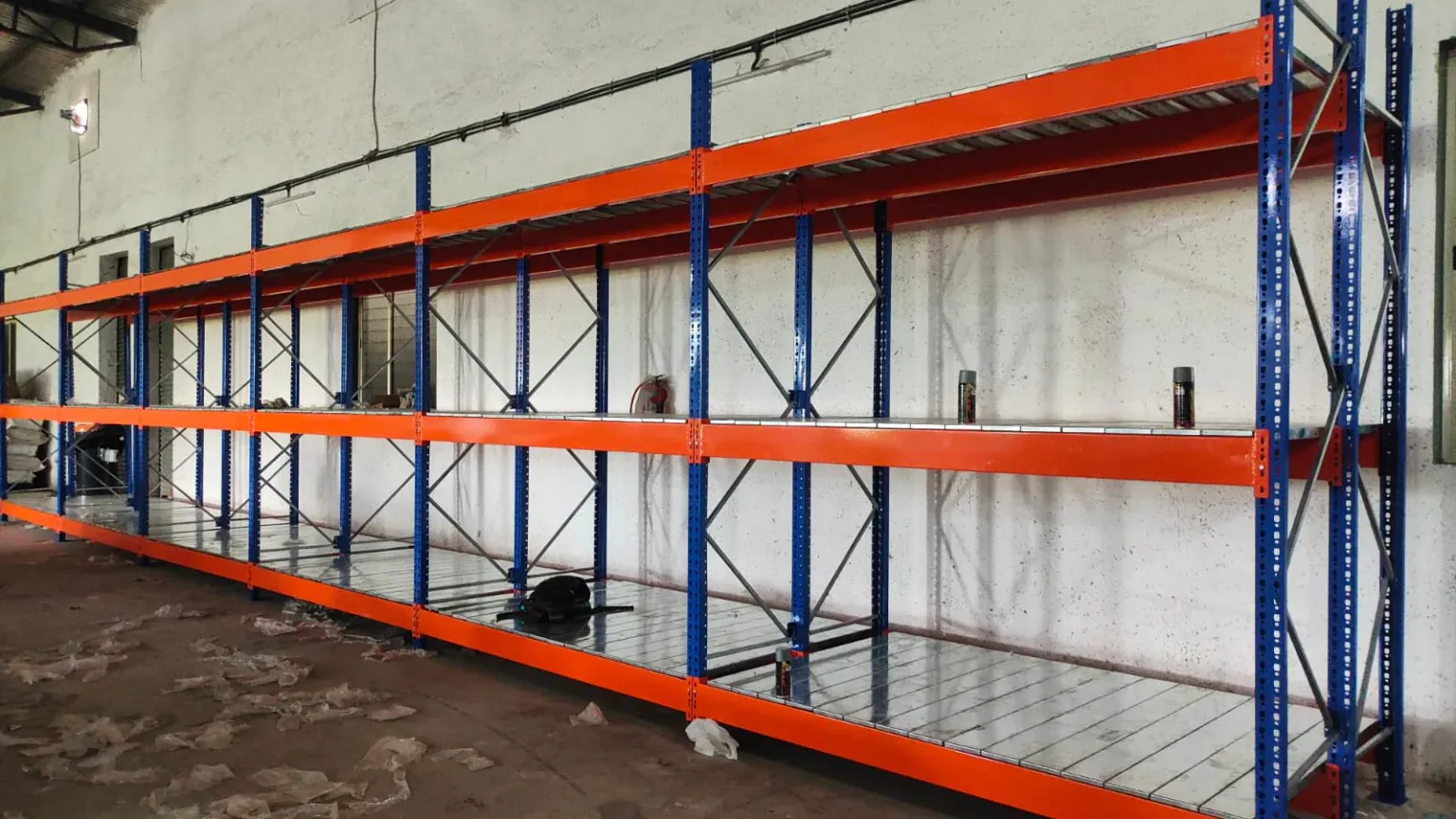
To move quickly, have these details ready for the consultation:
| Detail | Why we ask |
|---|---|
| Warehouse location | Travel, logistics and regional cost factors |
| Warehouse length and width | Footprint for layout options |
| Clear ceiling height | Number of storage levels available |
| Pallet dimensions | Bay sizing and beam lengths |
| Maximum weight per loaded pallet | Beam pair and frame capacity |
| Number of SKUs | Density vs selectivity trade-off |
| Required pallet positions | Scale and system candidates |
| Forklift or stacker details | Aisle width and lift height |
| Contact name, company, phone, email | Where to send the proposal |
| Additional requirements | Timelines, phasing, special storage rules |
Book a Request a Free Site Survey & Layout Consultation with our team, or Get a Custom Pallet Racking Quote by sharing your details — either way, you will get guidance based on your building and your loads, not a catalogue page.
Products in this guide
Systems worth comparing
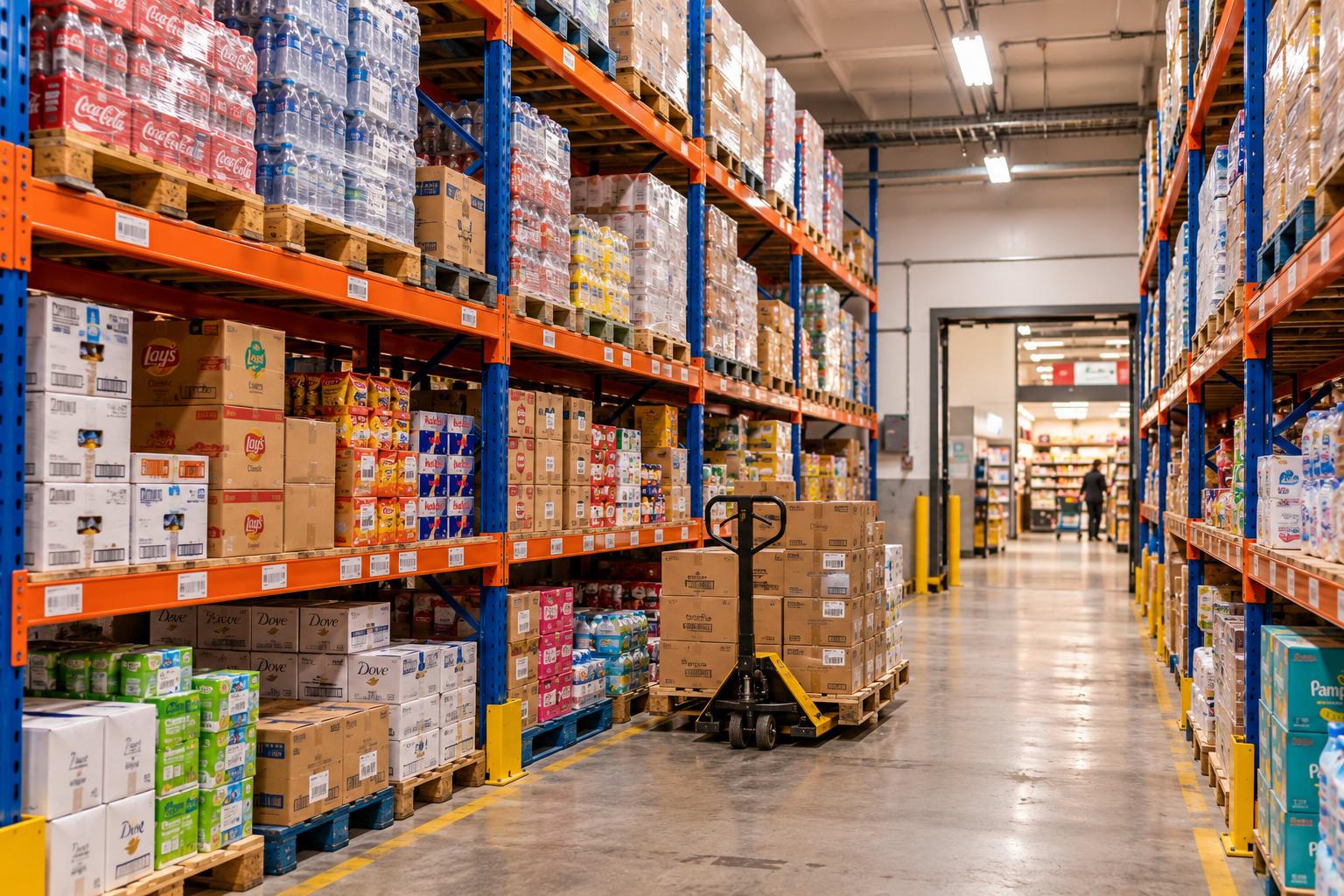 View Product
Conventional pallet racking system for selective pallet storage, allowing direct access to every pallet and efficient use of warehouse space with standard material-handling equipment.
System typeSelective conventional pallet racking
ApplicationsWarehousing and distribution centres
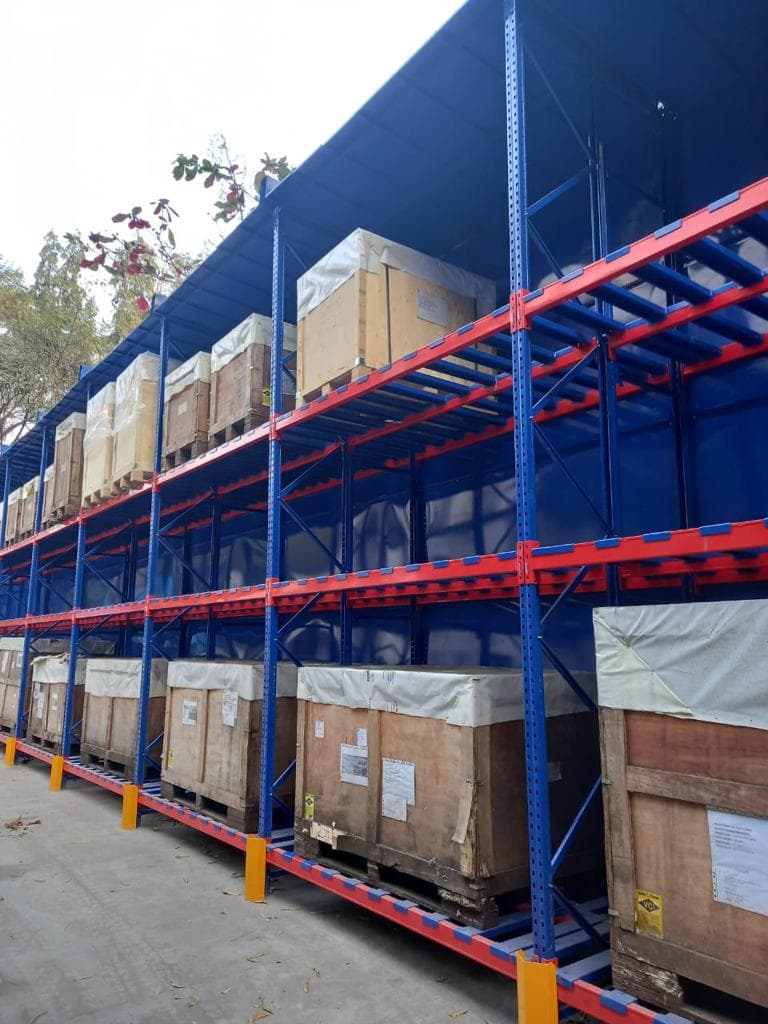 View Product
Engineered for high-load industrial warehousing, our heavy-duty pallet racks provide structural stability for unitized pallet loads. Constructed with high-strength upright frames, braced channels, and adjustable box or step beams, these systems integrate seamlessly with standard timber, plastic, and steel pallets.
Structure TypeHeavy-Duty Adjustable Industrial Pallet Racking System (Single-Deep, Double-Deep, or High-Bay configurations)
ApplicationsWarehouses and 3PL distribution centres
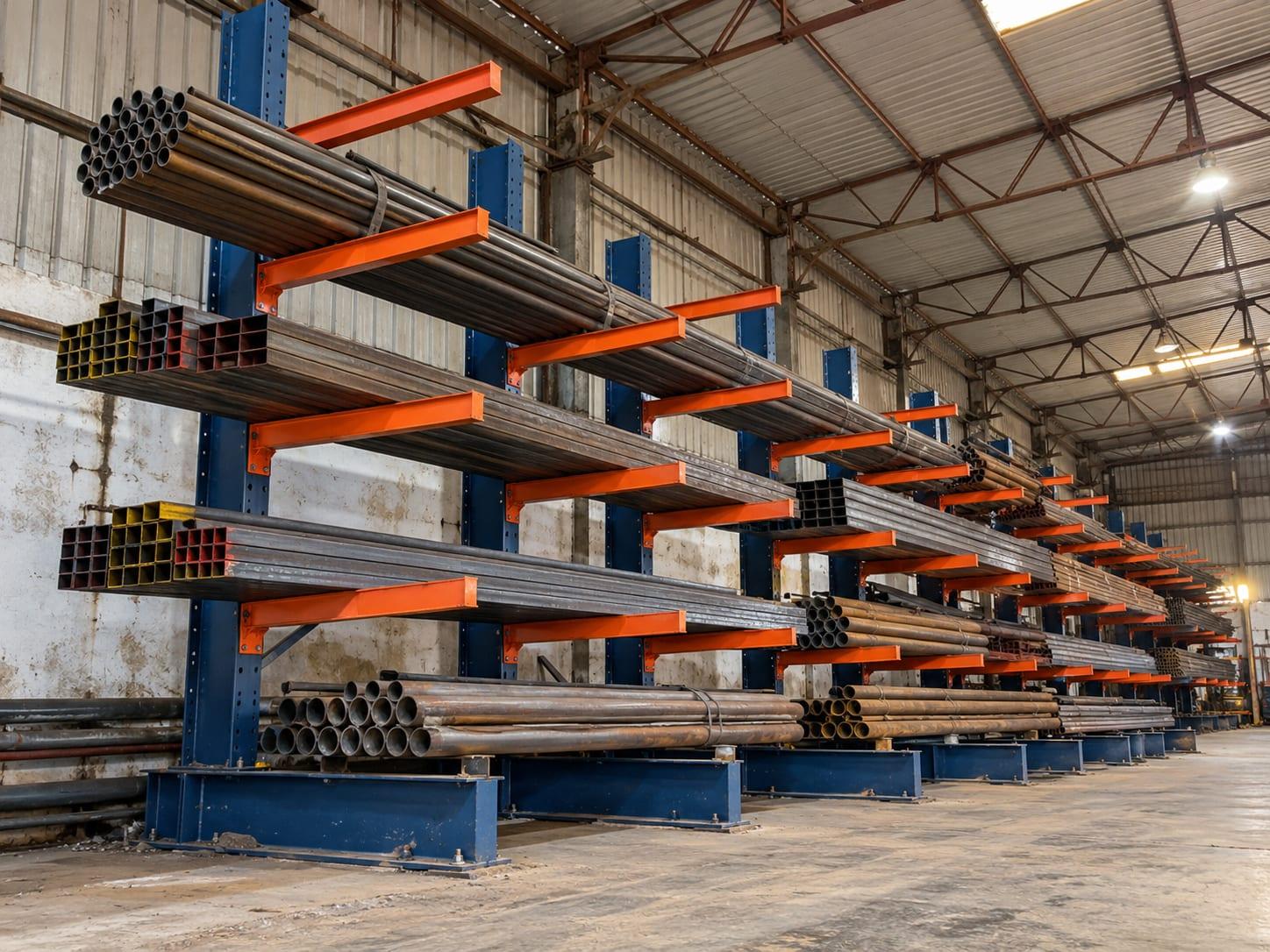 View Product
Cantilever racking system for safe, organised storage of long, bulky and irregular items like pipes, sections, panels and timber, with open front access.
System typeCantilever racking (single-sided or double-sided)
ApplicationsSteel and metal service centres
 View Product
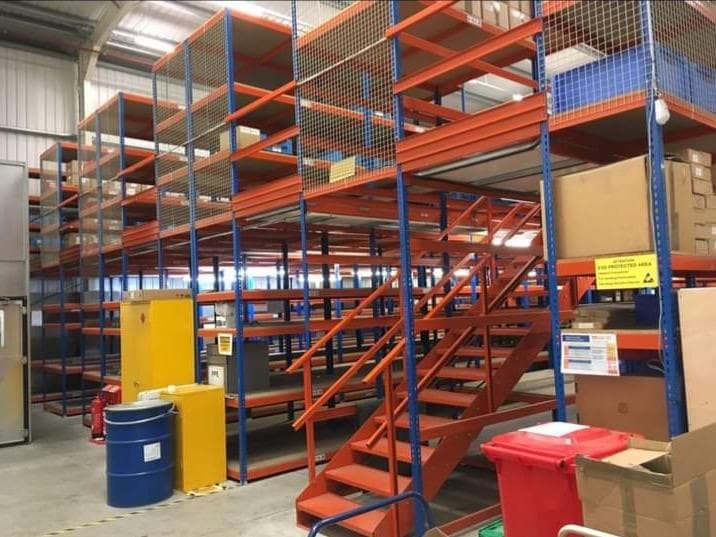
Unlock unused overhead headroom by adding a structural steel intermediate floor. Our free-standing and rack-supported mezzanine rack systems create additional floor area for storage, assembly lines, packing stations, or in-plant offices.
Structure TypeElevated Intermediate Floor (Free-standing structural steel or Rack-supported mezzanine)
ApplicationsWarehouses and distribution centres
Start a Conversation
Planning a storage project?
Share your space, loads and handling equipment. We will help you work out which system fits before anything is quoted.